How to Clean an Electric Mountain Bike (Without Wrecking the Motor)

the short answer
Turn the battery off or take it out, close the port covers, and rinse with plain, low-pressure water. Never use a pressure washer or steam cleaner: Bosch says water can get into the motor, hub and frame bearings, and DJI warns of fire. Wash with mild soap, dry with a soft cloth, keep the connectors dry, then lube the chain.
Cleaning an e-MTB is mostly like cleaning any mountain bike, with two big differences: no pressure washer, ever, and the battery and electrics come first. Get those right and a bucket, a sponge and a soft cloth do the rest. I've ridden an e-MTB through Forest of Dean winters since 2018, and the wash afterwards is also the best time to see what the mud has been doing to your parts.
Can you pressure wash an e-bike?
No. Bosch and DJI both say so.
- Bosch says never use a steam cleaner or a high-pressure cleaner on an e-bike, because water can get into the bearings of the motor, the hubs and the rear frame.
- DJI's Avinox manual says never use a high-pressure water spray on the motor, the battery or any electrical parts, because it may cause a fire.
- Bosch's battery advice, via Tern, adds that a battery must never be submerged or cleaned with a direct jet of water or a high-pressure hose.
What about the IP rating? DJI rates Avinox batteries IP56 and drive units IP66. Don't read that as permission to jet-wash: the same maker's manual still says no high-pressure water on the motor, battery or electrics. That rules out the pressure washer at home and the jet wash at the petrol station.
How to clean an electric mountain bike, step by step
- Battery off, covers closed. DJI says turn the battery off and close the charging-port and Type-C covers before you clean. Bosch suggests taking the battery and display off first, or covering them with a cloth or film.
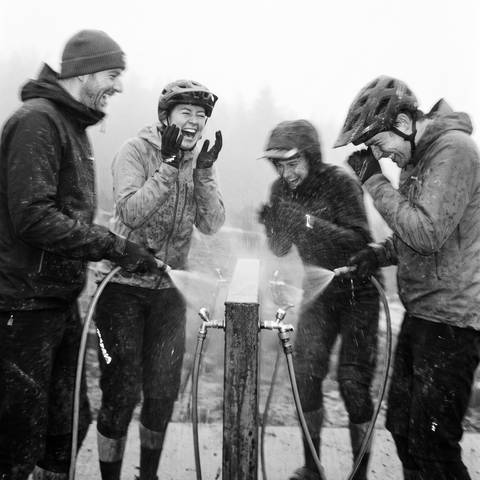
- Rinse with plain water, gently. Bosch says plain water is fine, as long as it isn't from a steam cleaner. A bucket and sponge, or a hose on a gentle setting, is plenty. Keep the flow off the battery, display, motor and bearings.
- Wash with a mild soap. DJI's manual suggests a damp cloth and a neutral detergent on the drive system, and Fox says mild soap and water only on its shocks. Keep cleaning products out of the battery port.
- Clean the drivetrain. Brush the chain, cassette and chainring. If you use a degreaser, keep it well away from the discs and pads.
- Dry it. A soft, dry cloth on the motor and battery, and a soft towel on the shock, as Fox says. Make sure the connectors are clean and dry.
- Lube the chain once it's dry, and wipe off the excess.
- Check it over while it's clean (see below), then refit the battery and charge it indoors.
Looking after the battery, motor and connectors
These are the parts you can't fix with a spanner, so they get the gentlest treatment.
- Battery. Wipe it with a damp cloth or sponge. Keep water and cleaning products out of the port, and never submerge it. For charging and storage, see my e-bike battery care guide.
- Connectors. DJI's current manual says keep the electrical connectors clean and dry, and never put grease or adhesive on them. That goes against the old habit of greasing anything that might get wet, so it's worth saying.
- Motor. A cloth, not a hose. While you're there, look at the motor seals. Water or rust there, play in the cranks, or grinding or knocking under load all mean booking the drive system in with your dealer. Never open the motor or the battery, and leave the motor bolts to the dealer too.
If you ride an Avinox bike, how to maintain DJI Avinox has the rest of what the manual says.
Suspension, brakes and chain after a wash
A clean bike is the easiest one to inspect. Three things to look at every time:
- Suspension. Wipe the stanchions and look for dry legs or a ring of oil after the ride, both signs a lowers service is due. My e-MTB suspension service guide has the intervals.
- Brakes. Wet grit eats pads. SRAM says replace pads when the backing plate and pad material together are less than 3 mm thick. Shimano says replace a pad at 0.5 mm or below, and stop using the brakes if a rotor is worn to 1.5 mm or the aluminium shows. More in how long e-MTB brake pads last.
- Chain. Check it with a chain checker. Park Tool's guideline is to replace at 0.5% wear on 11-speed and up, and 0.75% on 10-speed and below. My e-bike chain wear guide explains why e-bikes get through chains faster.
After a muddy Forest of Dean ride: what to check
The ground decides how much work the wash is. Round here:
- Mallards Pike is loam cut down to the stone. It always runs well in the wet, but heavy rain ruts it up pretty badly.
- Fetter Hill is good all year round, wet included: good roost spray and loam flying about, and some of it comes home on the bike.
- Staunton is clay, and in the wet it's lethal: it turns to ice. I'd leave it alone until it dries out.
- The Cycle Centre always runs pretty well, because the stone, man-made trails give grip in the wet.
Then there are the sniper roots, the tree roots that catch you out, dotted around the off-piste riding. A day of those and a lot of loam means a few extra checks:
- Tyres. Look for sidewall cuts and torn or rounded edge knobs.
- Bolts. A quick check of the ones you'd normally reach with a multi-tool. Not the motor bolts: they're dealer work.
- Wheels. Spin them and watch for a wobble or a dented rim.
- Motor seals and battery contacts. Water or rust at the seals goes to the dealer, and the contacts should be clean and dry.
Ride responsibly
The natural lines at Mallards Pike, Fetter Hill and Staunton are unwaymarked trails. Forestry England asks riders to stick to stone-surfaced forest roads, formal waymarked trails and bridleways, and building trails or features without consent is illegal. If you ride them, you do so at your own risk: ride within your limits, don't build or dig, and give way to walkers and forestry work.
E-MTB winter maintenance: why the wet wears everything faster
A wet winter doesn't just mean more washing. It wears parts out quicker, and an e-bike's torque and weight add to that. The free Plus1 Garage builds both into its starting estimates. From a baseline of UK mixed riding on drip lube, riding mostly in the wet cuts the life of the chain, cassette and chainring to 0.55 of normal, front pads to 0.5, rear pads to 0.45 and rotors to 0.55. On top of that, an e-bike's drivetrain starts at 0.6.
So an e-bike chain starts at 900 × 0.6 = 540 miles, and ridden mostly in the wet on drip lube that comes down to about 300 miles. Lube changes the estimate too: a waxed chain starts at twice the life of drip lube, and wet lube at 0.7. That's a starting estimate, and a chain checker has the final word.
The rest of the winter list:
- Suspension. Fox says wet, muddy and winter riding means servicing more often than its standard intervals.
- Battery. Cold cuts performance. Below 0 °C, Bosch says bring the battery indoors and let it warm up before you ride, and charge it in the house rather than the shed.
The Garage keeps washing the e-bike safely, chain lube, tyre pressure, a bolt check and battery contacts on a routine checklist, and sends a reminder on the day a part is due, nothing more. Type in the miles off your display now and then, and when you've checked a part and it's fine, tell it. It's a tracker with best-guess numbers, not a mechanic, but it means a winter of wet miles gets counted.
For everything on one page, see the e-MTB maintenance schedule.
Questions riders ask
Can you pressure wash an e-bike?
No. Bosch says never use a high-pressure or steam cleaner on an e-bike, because water can get into the motor, hub and rear-frame bearings, and DJI's Avinox manual says high-pressure water on the motor, battery or electrics may cause a fire.
Can I use a hose on my e-bike?
Plain water is fine, as long as it isn't from a steam cleaner or a pressure washer. Keep it gentle, and don't aim a direct jet at the battery, display, motor or bearings.
Should I take the battery out before washing my e-bike?
Bosch suggests taking the battery and display off first, or covering them with a cloth or film. DJI says turn an Avinox battery off and close the charging-port and Type-C covers before cleaning.
What should I clean an e-bike with?
Plain water, a mild soap and soft cloths. DJI suggests a damp cloth and neutral detergent on the drive system, and Fox says mild soap and water only on its shocks, wiped dry with a soft towel.
Is an e-bike waterproof?
DJI rates Avinox batteries IP56 and drive units IP66, but its manual still says never use high-pressure water on the motor, battery or electrical parts. Don't read the rating as permission to jet-wash.
Do I need to lube the chain after washing?
Yes, once it's dry, and wipe off the excess. Wet riding wears chains fast: the free Plus1 Garage cuts its starting estimate for chain life to 0.55 of normal for mostly wet riding.
What should I check after a muddy ride?
Brake pad thickness, chain wear, the fork stanchions for oil or dry legs, tyre sidewalls and knobs, and the motor seals for water or rust. Anything wrong at the motor goes to your dealer.
sources
- Forestry England: cycling and mountain biking in the Forest of Dean, checked 25 September 2026
- Bosch eBike Systems: care of eBikes, checked 26 September 2026
- Tern: How to care for your Bosch e-bike battery, checked 26 September 2026
- DJI Avinox: Drive System User Manual v1.0, checked 26 September 2026
- DJI Avinox: Drive System User Manual (2026), checked 26 September 2026
- DJI Avinox: FAQ, checked 26 September 2026
- Fox: service intervals (owner's manual tech centre), checked 26 September 2026
- SRAM: MTB disc brake pad replacement (PDF), checked 26 September 2026
- Shimano: disc brake user manual (via Starbike), checked 26 September 2026
- Park Tool: when to replace a chain on a bicycle, checked 26 September 2026