E-MTB maintenance schedule: every ride, every month, by the mile and every year

the short answer
Check tyres, brakes, chain lube and battery before every ride. Monthly, measure chain wear and look at pads, rotors and tyres. Replace parts by the mile: the Plus1 Garage starts an e-MTB chain at 540 miles, about 300 mostly in the wet. Service the suspension by the hour, and the drive system at a dealer once a year.
An e-MTB needs the same jobs as any mountain bike, just more often. Here's the schedule I'd follow: a quick check before every ride, a proper look once a month, parts replaced by the mile, and the suspension, brakes and drive system serviced by the hour and the calendar.
The intervals in miles, hours and months are the starting estimates from the free Plus1 Garage, built from the part makers' guidance and adjusted for e-bikes. I've put the makers' own figures alongside. Treat every number as a starting point: a chain checker, the pad limit and your own eyes have the final word.
Why an e-MTB needs a tighter schedule
Torque and weight. DJI's Avinox M2S motor gives up to 130 N·m in its regular assist modes and up to 150 N·m in Boost, according to the Avinox FAQ. The Avinox M2S bikes that E-MOUNTAINBIKE lists from Amflow, Atherton, Megamo, Mondraker, Pivot and Raymon weigh 21.4 to 24.2 kg in the sizes it quotes. Everything that drives, stops and grips the bike takes more load, so it wears out sooner.
The starting estimates in this guide shorten part life for an e-bike like this:
| What | Share of a normal bike's life |
|---|---|
| Chain, cassette and chainring | 60% |
| Brake pads and rotors | 70% |
| Front tyre | 55% |
| Rear tyre | 50% |
| Fork, shock and headset servicing | 85% |
| Pivot bearing checks | 80% |
Then there's where you ride. I've ridden e-MTBs in the Forest of Dean since 2018, and our winters are wet. Some of the riding here is clay-based and turns to ice in the wet. Some is loam cut down to the stone, with loam flying about all year round. On the starting estimates, riding mostly in the wet cuts the chain, cassette, chainring and rotors to 0.55 of their e-bike life, the front pads to 0.5 and the rear pads to 0.45. Fox says much the same about suspension: if you often ride in wet, muddy or winter conditions, service more often.
Before every ride
Two minutes in the car park, or before you roll out of the shed. These are routine checks, not jobs with a due date.
| Check | What you're looking for |
|---|---|
| Tyres | Pressure where you like it, and no cuts in the sidewalls |
| Brakes | A firm lever and a bite point that stays put. A soft lever or a wandering bite point means a bleed is due now. |
| Chain | Clean and lubed, not dry |
| Bolts | A quick bolt check. Leave the motor bolts to the dealer. |
| Battery | Charged, with the connectors clean and dry. DJI's Avinox manual says never grease them. |
| Cold mornings | Below 0 °C, Bosch recommends bringing the battery into a heated room and letting it warm to room temperature before you ride. |
After every ride, especially a wet one
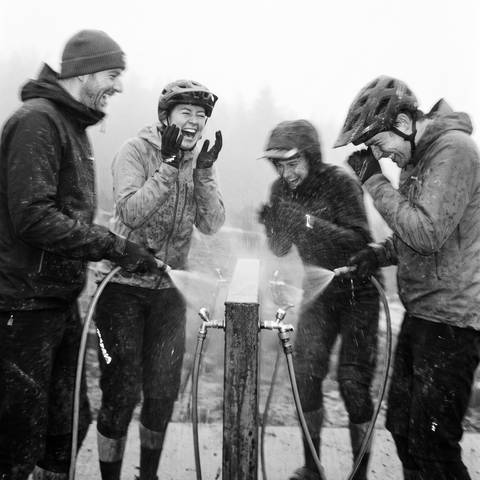
- No pressure washer, no steam cleaner. Bosch says high pressure can force water into the bearings of the motor, hubs and rear frame. DJI's Avinox manual warns that a high-pressure spray on the motor, battery or electrics may cause a fire.
- Battery off, covers shut. Avinox says to turn the battery off and close the charging-port and Type-C covers before cleaning. Bosch suggests taking the battery and display off, or covering them with a cloth or film.
- Plain water is fine. Bosch says water is never wrong, as long as it doesn't come from a steam cleaner. On the drive system, Avinox suggests a soft dry cloth, or a damp cloth and neutral detergent if needed. Fox says to clean a shock with mild soap and water only and wipe it dry with a soft towel.
- Dry and relube the chain. A wet winter shortens its life enough without leaving it dirty.
- Look at the fork legs. An oil ring after a ride is one of the signs a lower-leg service is due.
My guide to cleaning an e-bike goes through it step by step. For charging and storage, see e-bike battery care.
Every month
Once a month, and more often through a wet winter, get the bike on a stand and measure rather than guess.
| Check | Replace or act when |
|---|---|
| Chain wear | 0.5% on 11, 12 and 13-speed chains; 0.75% on 10-speed and below (Park Tool). The Garage suggests a three-point checker, as two-sided ones can misread SRAM Flattop chains. |
| Brake pads | SRAM: under 3 mm for pad and backing plate together. Shimano: 0.5 mm of pad material or less. |
| Rotors | At the minimum stamped on the rotor. Shimano says stop using the brakes at 1.5 mm, or if the aluminium shows. |
| Rear tyre | Centre knobs worn to about half height |
| Front tyre | Edge knobs rounded or torn, casing showing, or sidewall cuts |
| Fork | Dry legs, an oil ring after a ride, or a knock: book the lower-leg service now |
| Tubeless sealant | Every 3 months. Shake the wheel, and if nothing sloshes, top it up. |
The chain check is the one that saves the most money. Park Tool says a worn chain slips under load or causes chain suck, that running one past its limit wears out your cogs and chainrings early, and that a cassette costs far more than a chain. There's more in my guides to e-bike chain wear, e-MTB brake pads and e-MTB tyres.
By the mile: parts that wear out
These are the starting estimates in miles. "E-bike" is the normal life times the e-bike factor. "E-bike, mostly wet" puts the wet-riding factor on top, on drip lube.
| Part | Normal bike | E-bike | E-bike, mostly wet |
|---|---|---|---|
| Chain | 900 | 540 | about 300 |
| Cassette | 2,700 | 1,620 | about 890 |
| Chainring | 3,600 | 2,160 | about 1,190 |
| Front pads | 620 | about 430 | about 220 |
| Rear pads | 500 | 350 | about 160 |
| Rotors | 1,500 (or 12 months) | 1,050 | about 580 |
| Front tyre | 1,100 | about 600 | no wet adjustment |
| Rear tyre | 620 | 310 | no wet adjustment |
Here's the chain worked through: 900 × 0.6 = 540 miles on an e-bike, then 540 × 0.55, about 300 miles, ridden mostly in the wet. Ride mostly in the dry and it goes the other way: the drivetrain gets 1.25 times its life and the pads 1.3 times. Lube matters too. A waxed chain lasts twice as long as one on drip lube, and wet lube gets 0.7.
To put the wet number in real terms: on that starting estimate, someone riding 30 miles a week in the wet would reach it in about ten weeks. That's why the monthly check matters most in winter.
By the hour and the calendar: suspension, brakes and bearings
Suspension makers count in hours. If you don't log yours, the calendar is the backstop.
| Service | Starting estimate | E-bike | What the makers say |
|---|---|---|---|
| Fork lower-leg service | 50 hours, 400 miles or 6 months | 340 miles | RockShox's chart starts lower-leg services at 50 hours |
| Full fork service | 125 hours, 1,000 miles or 12 months | 850 miles | Fox air-spring forks (32, 36, F-Series, FLOAT, TALAS): every 100 hours or annually. RockShox: 100 hours on most older forks, 200 on newer ones (per a bike shop's summary) |
| Shock air-can service | 50 hours or 400 miles | 340 miles | Fox: air sleeve every 30 hours |
| Full shock service | 125 hours, 1,000 miles or 12 months | 850 miles | Fox: every 100 hours or annually. RockShox: 100 to 200 hours, by model |
| Pivot bearings (check) | 100 hours, 800 miles or 6 months | 640 miles | |
| Headset | 100 hours, 800 miles or 12 months | 680 miles | |
| Dropper service | 100 hours, 800 miles or 12 months | No change | |
| Brake bleed | 12 months | No change | Sooner if the lever goes soft or the bite point wanders |
Fox's rear shock fluid service is done by Fox or an authorised service centre, so it's a booking, not a Sunday job. What a lowers service involves, and how it differs from a full service, is in my e-MTB suspension service guide.
Every year: the drive system and the battery
| Job | When | Notes |
|---|---|---|
| Drive system dealer service | 1,850 miles or 12 months | Sooner if the cranks have play, it grinds or knocks under load, or there's water or rust at the motor seals |
| Firmware (check) | Every 6 months | Avinox riders update through the Avinox Ride app |
| Battery health check | Every 12 months | 80% or less is getting tired; 70% or less is worn out |
| Battery replacement | Around 96 months | Or at 70% health, or when the range has clearly dropped |
If you lay the bike up for the winter, store the battery properly. Bosch says to take the battery and display off and keep them somewhere dry at room temperature, ideally 10 to 20 °C, at 30 to 60% charge. DJI's Avinox manual says to take the battery out of the frame for long-term storage, keep it at about 30% charge, and store it somewhere cool and dry, out of direct sunlight, between 0 and 40 °C.
Leave the motor and battery to the dealer
Motor bolts and anything inside the drive system are dealer work. Never open a motor or a battery, and don't modify the drive system: Avinox says any modification voids the warranty and may break the law, and that third-party range extenders aren't compatible and could be a fire hazard. If a battery is swollen, damaged or showing an error, stop using it and don't charge it.
Avinox riders can also set a charge limit of 100, 95, 80 or 70% in the Avinox Ride app. My guide on how to maintain DJI Avinox covers the manual in full, and DJI Avinox tips covers the modes and the charge limit. Still choosing a bike? Here are the DJI Avinox e-bikes you can buy. If your last bike wasn't an e-bike, expect whichever you pick to eat parts faster.
Why a schedule beats memory
The trouble with a schedule is keeping to it. On an e-bike the miles pile up quickly, and every job runs on a different clock: the chain by the mile, the fork by the hour, the sealant every three months, the bleed once a year. Nobody remembers all of that, and the jobs you forget are the expensive ones.
That's what the Garage is for. Type in the odometer off your display now and then, and every part gets a bar: fine, coming up (from 80% of its life) or due. You get a reminder on the day something's due, and nothing else. Checked a part and it's fine? Tell it, or set where it is in its life in one tap. It's a free tracker with best-guess numbers you can correct, not a mechanic, so the chain checker and the dealer still have the final say. Here's how it all works.
Questions riders ask
How often should you service an e-MTB?
Check it before every ride, measure the chain and look at the pads, rotors and tyres once a month, replace parts by the mile, service the suspension by the hour, and book the drive system in with a dealer. The Plus1 Garage's starting interval for that is 12 months or 1,850 miles.
How long does an e-bike chain last?
The Plus1 Garage starts an e-bike chain at 540 miles (900 × 0.6), and about 300 miles ridden mostly in the wet on drip lube. It's a starting estimate: replace at 0.5% wear on 11 and 12-speed chains, 0.75% on 10-speed and below. More in e-bike chain wear.
How often should an e-bike fork be serviced?
Fox's owner's manual lists every 100 hours or annually for its air-spring forks (the 32, 36, F-Series, FLOAT and TALAS), and RockShox's chart starts lower-leg services at 50 hours. Fox says to service more often if you ride a lot in wet, muddy or winter conditions.
Can you pressure wash an e-MTB?
No. Bosch says never use a steam cleaner or high-pressure cleaner on an eBike, and DJI's Avinox manual warns that a high-pressure spray on the motor, battery or electrics may cause a fire. Plain water is fine.
When should e-MTB brake pads be replaced?
At the maker's limit: SRAM says under 3 mm for pad and backing plate together, Shimano 0.5 mm of pad material. On an e-bike the Plus1 Garage starts rear pads at 350 miles, and about 160 ridden mostly in the wet.
How often should I check my e-bike battery?
Keep the connectors clean and dry every ride, and check its health once a year. The Plus1 Garage treats 80% or less as getting tired and 70% or less as worn out. If a battery is swollen, damaged or showing an error, stop using it and don't charge it.
Is an e-bike service different from a normal bike service?
Most of the jobs are the same; the parts just wear faster. The difference is the drive system: motor bolts and anything inside it are dealer work, so book a dealer service once a year and keep the firmware up to date.
sources
- Avinox: System FAQ, checked 26 September 2026
- E-MOUNTAINBIKE: Bikes with the Avinox M2S motor, checked 26 September 2026
- Park Tool: CC-4 chain checker, checked 26 September 2026
- Park Tool: When to replace a chain on a bicycle, checked 26 September 2026
- SRAM: MTB disc brake pad replacement, checked 26 September 2026
- Shimano: Disc brake user's manual, checked 26 September 2026
- Fox: Service intervals (owner's manual), checked 26 September 2026
- SRAM/RockShox: Service interval chart, checked 26 September 2026
- Cardinal Bicycle: RockShox service intervals, checked 26 September 2026
- Bosch eBike Systems: Care of eBikes, checked 26 September 2026
- Bosch eBike Systems: 12 questions about the eBike battery, checked 26 September 2026
- DJI Avinox: Drive System User Manual v1.0, checked 26 September 2026
- DJI Avinox: Drive System User Manual (2026), checked 26 September 2026