How to Maintain a DJI Avinox E-Bike: Cleaning, Battery, Firmware and the Parts That Wear

the short answer
Clean it with the battery off and the charging-port and Type-C covers shut, never with a pressure washer. Keep the connectors clean, dry and grease-free. For long-term storage, take the battery out at about 30% charge and keep it cool and dry. Update firmware in the Avinox Ride app, and leave the motor and battery internals to a dealer.
Looking after a DJI Avinox bike is mostly looking after the bike around it. The motor and battery ask very little of you, as long as you follow a handful of rules from DJI's manual. The chain, cassette, brake pads and tyres ask a lot more, because an Avinox motor puts serious torque through them.
I've ridden e-MTBs in the Forest of Dean since 2018, through a lot of wet winters, clay and mud. Here's what DJI actually says about caring for the system, what to leave to a dealer, and which parts to keep an eye on.
How to clean a DJI Avinox bike
DJI's Avinox drive system manual is short and clear on cleaning:
- Turn the battery off and close the covers on the charging port and the Type-C port before you start.
- Never use a high-pressure water spray on the motor, the battery or any electrical part. DJI's reason is blunt: it may cause a fire.
- Wipe the motor and battery with a soft, dry cloth. If that won't shift the dirt, use a damp cloth and a neutral detergent.
Bosch gives one more reason to leave the pressure washer in the shed, and it applies to any e-bike: high pressure pushes water into the bearings of the motor, the hubs and the rear frame. It rules out steam cleaners too, and says plain water is fine as long as it doesn't come from one.
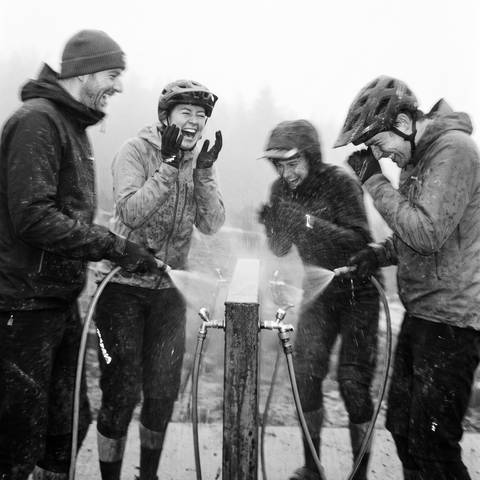
So when the bike comes home from a winter ride plastered in Forest clay and loam, it's a bucket of plain water and a soft brush for the frame and wheels, a cloth for the motor and battery, and never a jet. Fox's advice for the rear shock fits the same routine: mild soap and water only, then wipe it dry with a soft towel. Once the bike's clean and dry, relube the chain.
My guide to cleaning an e-bike goes through the whole wash, step by step.
Is DJI Avinox waterproof?
DJI rates its drive units at IP66 and its batteries at IP56. Don't read either rating as permission to jet-wash: the manual's no-high-pressure rule stands, whatever the rating says.
DJI gives the system's normal operating temperature as -10 to 40 °C. Charging has a narrower range, which comes next.
Connectors, charging and battery checks
Two rules here catch people out.
First, keep the electrical connectors clean and dry, and never put grease or adhesive on them. That's straight from DJI's current manual. If you're used to greasing everything on a bike, this is the exception.
Second, charge the battery between 0 and 40 °C. If your garage or shed drops below freezing on a January night, that's outside DJI's range, so bring the battery indoors to charge it. My Avinox settings and tips guide covers charge limits and charging times.
Look the battery over before it goes on charge. If it's swollen, damaged or showing an error, stop using it and don't charge it. Take it to your dealer.
How to store an Avinox battery over winter
If the bike is going to sit for a while, DJI's manual says:
- Take the battery out of the frame for long-term storage, and keep it out of reach of children.
- Store it at about 30% charge. DJI says that's to prevent the battery ageing or over-discharging.
- Keep it cool and dry, out of direct sunlight, between 0 and 40 °C.
For shorter gaps between rides, the Avinox Ride app lets you cap charging at 100, 95, 80 or 70%, so the battery isn't sitting at full for days on end. There's more on keeping any e-bike battery healthy in my e-bike battery care guide.
Firmware updates and the Avinox Ride app
Firmware comes through the Avinox Ride app, DJI's companion app. The FAQ tells owners on firmware older than V00.11.03.04 to update through the app.
Updates can change how the bike rides. On the first-generation M1, a software update (v1.2) raised peak power from 750 to 1,000 watts. If you've bought a used Avinox bike, checking for updates is one of the first jobs. After that, a look every six months is a good habit.
What's dealer work on an Avinox bike
Keep it simple: the outside of the bike is yours, and the inside of the motor and battery is not.
- Never open the motor or the battery. Motor bolts and anything inside the drive system are dealer work.
- Never modify the drive system. The manual says no unauthorised modifications, and the FAQ says any modification voids the warranty and may break the law. Only official Avinox parts work with it.
- No third-party range extenders. DJI says they aren't compatible: one can make the system malfunction, it voids the warranty, and it could be a fire hazard.
- The speed limit stays. DJI gives no way to remove it, and top speed has to follow local rules.
Book the bike in with a dealer if the cranks have play, the motor grinds or knocks under load, or there's water or rust at the motor seals. Otherwise, our starting estimate for a drive-system dealer service is every 12 months or 1,850 miles, whichever comes first.
The parts Avinox torque wears out faster
This is where most of your maintenance time and money goes. DJI's current M2S motor gives up to 130 Nm in its normal modes and 150 Nm in Boost. For comparison, Shimano's EP801 is quoted at 85 Nm. Add the weight of an e-bike, and the drivetrain, brakes and tyres all have a harder life.
These are the starting estimates the Plus1 Garage uses, built from the part makers' service guidance and adjusted for e-bikes. They assume UK mixed conditions and drip lube, and they're best guesses, not promises:
| Part | Normal bike | E-bike | Replace or service when |
|---|---|---|---|
| Chain | 900 mi | 540 mi | 0.5% stretch on 11 and 12-speed, 0.75% on 10-speed and below |
| Cassette | 2,700 mi | 1,620 mi | A new chain skips under load, or teeth look hooked or thin |
| Chainring | 3,600 mi | 2,160 mi | Hooked or shark-fin teeth |
| Front brake pads | 620 mi | about 430 mi | SRAM: under 3 mm of pad plus backing plate. Shimano: 0.5 mm of pad |
| Rear brake pads | 500 mi | 350 mi | As above |
| Rotors | 1,500 mi | 1,050 mi | The minimum stamped on the rotor (Shimano: 1.5 mm) |
| Front tyre | 1,100 mi | about 600 mi | Edge knobs rounded or torn, casing showing |
| Rear tyre | 620 mi | 310 mi | Centre knobs worn to about half height |
| Fork lower-leg service | 400 mi or 6 months | 340 mi or 6 months | Dry legs, an oil ring after a ride, or a knock |
My own Avinox bike has been harder on parts than even those numbers:
"Avinox absolutely kills cassettes. I've been through a chain in 200 miles and a cassette in 700 miles. Bear that in mind, but it's a small price to pay for the smile on your face."
Wet riding cuts the starting numbers again. An e-bike chain starts at 900 × 0.6 = 540 miles; ridden mostly in the wet on drip lube, that's 540 × 0.55, or about 300 miles. Through a Forest of Dean winter, that doesn't last long.
A chain checker has the final word. Park Tool's guideline is to replace 11 and 12-speed chains at or just before 0.5%, and a chain run past its limit wears out your cogs and chainrings too. The pad limits come from SRAM and Shimano. I've gone deeper on chain wear, brake pads, tyres and suspension servicing.
A simple Avinox routine
- After every muddy ride: battery off, covers shut, a gentle wash, dry it, relube the chain. Glance at the pads.
- Every month: check pad thickness and chain wear, and look over the connectors and charging port: clean, dry, no grease.
- Every three months: top up the tubeless sealant. Shake the wheel: no slosh means it needs more.
- Every six months: check for firmware updates in the Avinox Ride app, and get the fork lowers serviced (sooner if the miles say so).
- Every year: a dealer service for the drive system, a brake bleed, and a battery health check. At 80% health or less the battery's getting tired; at 70% or less it's worn out.
The three-monthly, six-monthly and yearly jobs, and the battery health thresholds, are the Garage's starting estimates, and they're all in my full e-MTB maintenance schedule.
The hard part isn't doing any of this. It's remembering when you last did it. That's what the Garage is for: add your bike, type in the miles off the display now and then, and it tells you on the day something's due. It won't replace a chain checker or a good mechanic, and every number in it is a best guess you can correct. But a reminder on the day the chain's due is cheaper than a new cassette.
Questions riders ask
How do you clean a DJI Avinox e-bike?
Turn the battery off and close the charging-port and Type-C covers first. Wipe the motor and battery with a soft, dry cloth, or a damp cloth and a neutral detergent if needed, and wash the rest of the bike gently with plain water.
Can you pressure wash a DJI Avinox bike?
No. DJI's manual says never to use a high-pressure water spray on the motor, battery or any electrical part, because it may cause a fire. Bosch adds that high pressure pushes water into the motor, hub and frame bearings.
Is DJI Avinox waterproof?
Not in a way that allows pressure washing. DJI rates Avinox drive units at IP66 and its batteries at IP56, but its manual still says never to use high-pressure water on the motor, battery or electrics.
How should I store an Avinox battery over winter?
Take it out of the frame, store it at about 30% charge, and keep it somewhere cool and dry, out of direct sunlight, between 0 and 40 °C and out of reach of children. That's DJI's own advice.
Should I grease the Avinox battery connectors?
No. DJI says to keep the electrical connectors clean and dry and never to put grease or adhesive on them.
How do I update DJI Avinox firmware?
Through the Avinox Ride app. DJI's FAQ asks owners on firmware older than V00.11.03.04 to update there. It's worth checking every six months or so.
Can I service the Avinox motor myself?
Only the outside. Never open the motor or battery: motor bolts and the drive system's internals are dealer work, and DJI says any modification voids the warranty and may break the law.
sources
- DJI Avinox: Drive System User Manual v1.0 (January 2025), checked 26 September 2026
- DJI Avinox: Drive System User Manual (April 2026), checked 26 September 2026
- DJI Avinox: FAQ, checked 26 September 2026
- DJI Avinox: official site and Avinox Ride app, checked 26 September 2026
- Bosch eBike Systems: Care of eBikes, checked 26 September 2026
- Fox: Service intervals (owner's manual), checked 26 September 2026
- ebike-mtb.com: DJI Avinox M1 software update, checked 26 September 2026
- Alberabike: DJI Avinox M2 2026, motor, power and range, checked 26 September 2026
- Park Tool: Chain Checker CC-4, checked 26 September 2026
- Park Tool: When to replace a chain on a bicycle, checked 26 September 2026
- SRAM: MTB disc brake pad replacement, checked 26 September 2026
- Shimano: Disc brake user's manual, checked 26 September 2026